
Subagent controls
A subagent works on an assignment in its own conversation. Its task handle lets the parent inspect progress and collect the outcome while continuing other work. Open the child conversation when you want to see what it actually received or did.
Which subagents the agent can start, the read-only roles and forks are described in Subagents. This page covers the controls for a child once it runs.
Inspect the assignment
Section titled “Inspect the assignment”Open Work, then the child’s row. The row shows the original assignment and available result. Open conversation takes you to the child’s transcript; the parent navigation returns you to the owning conversation.
A child shown through its durable task record appears once in Background work. Older records can lack an assignment or some controls; CLIO identifies missing descriptions rather than inventing an assignment.
You can also find earlier children in Runs → All states → Agents. Expand Details to read an assignment, or open its conversation link with the mouse or keyboard. The original conversation remains available after cancellation.
Pause and resume
Section titled “Pause and resume”Pause holds the child’s model execution and retains its context. The handle stays the same. Its accepted shell commands, downloads and other background tasks continue. Incoming messages and results remain queued while it is held.
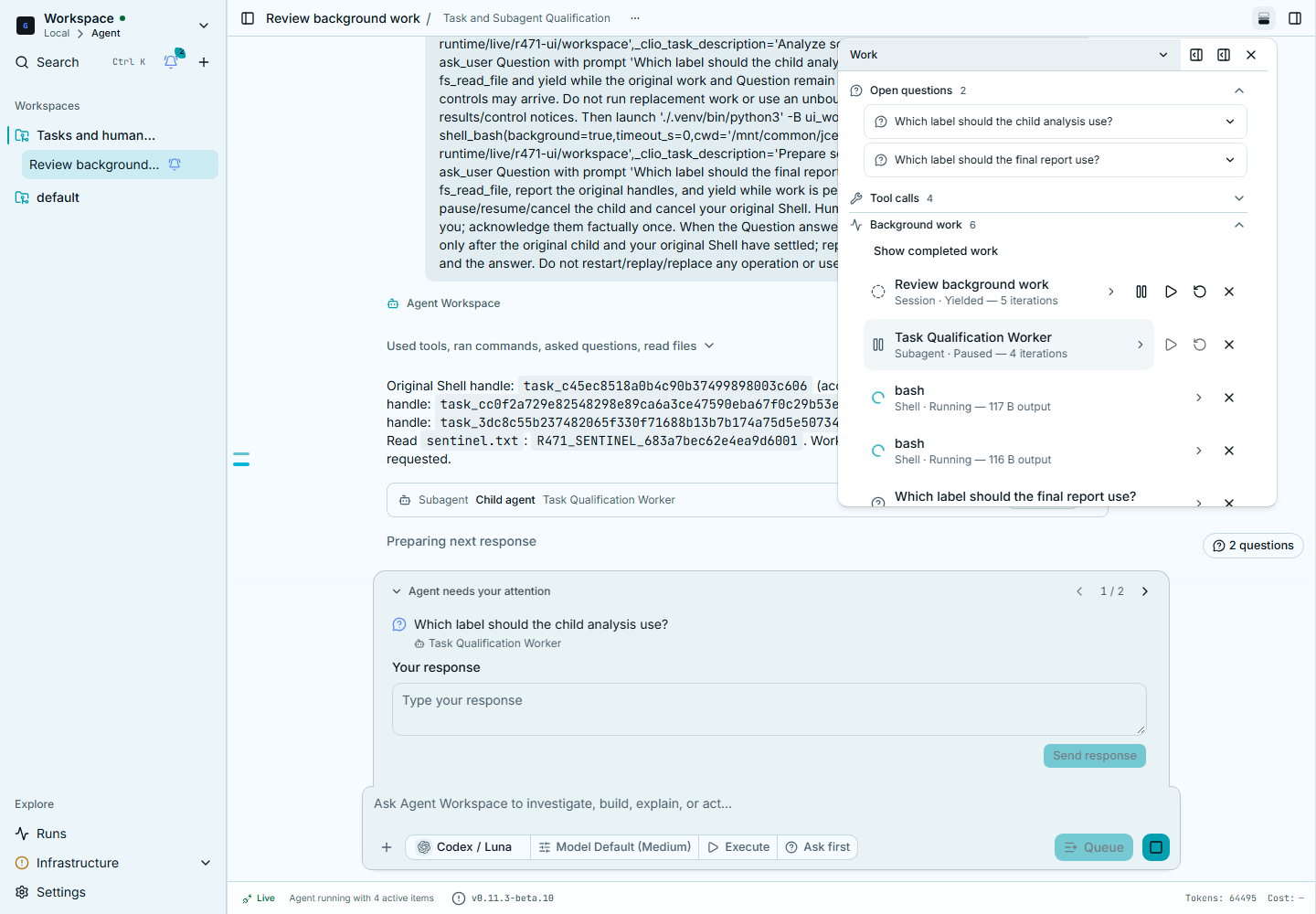
Resume lets the same run continue with its saved context and pending messages. Wait for a requested pause to settle before resuming. An ordinary peer message does not lift another agent’s pause.
Cancel the run and its descendants
Section titled “Cancel the run and its descendants”Choose × on the task. The confirmation names the task and warns that descendant agents, downloads and shell processes will also be cancelled. View assignment reveals the full original request before you decide. Keep running dismisses the dialog without cancelling anything.
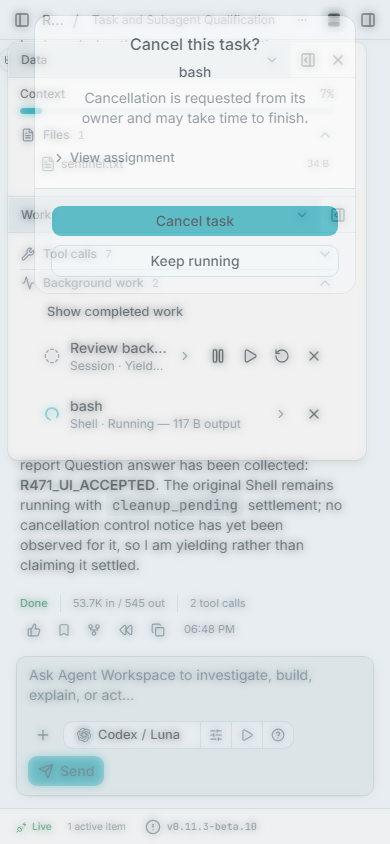
After confirmation, Cancellation requested means the owner is still settling. It is not proof that the process or transfer has stopped. The terminal outcome is published after the required owner settlement and cleanup.
Restart with a new handle
Section titled “Restart with a new handle”In Work or Observability, choose Show completed work to find an earlier subagent. Open its restart control and review the identifying confirmation. History pagination does not replace the list of currently active work.
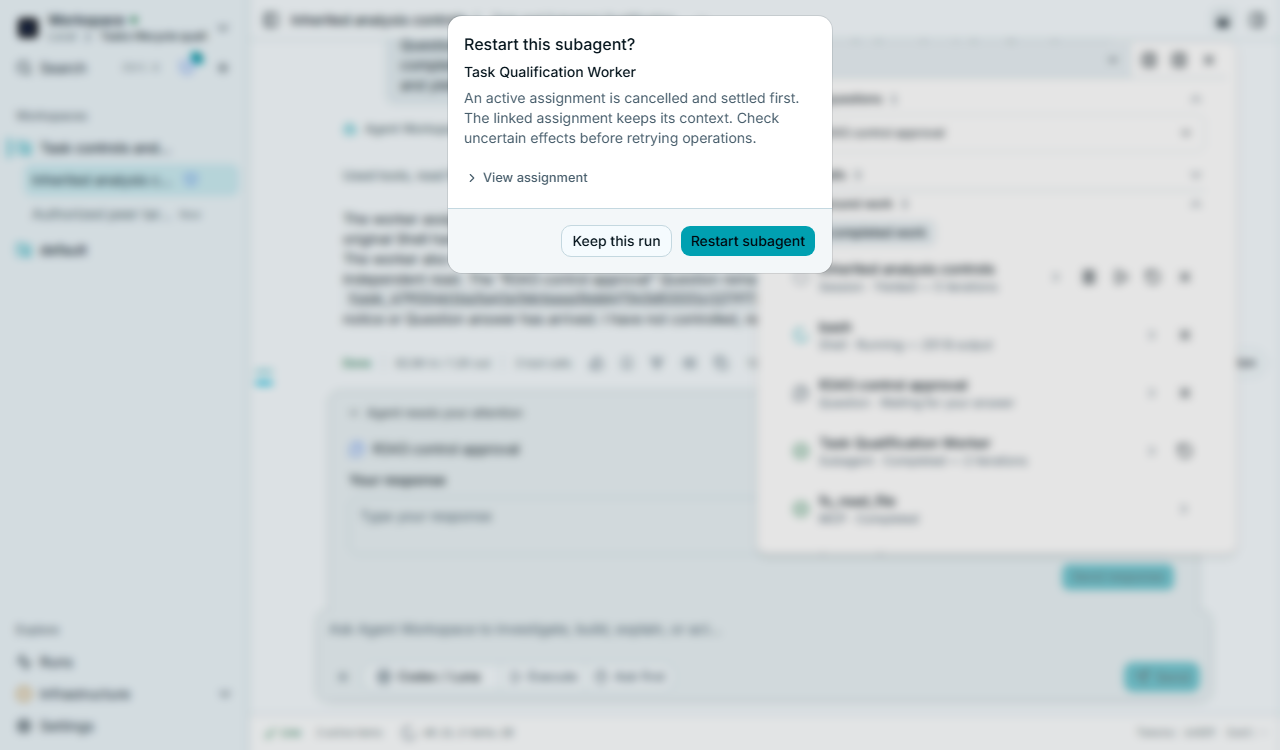
A restart creates a linked assignment with a new handle in the same session. It references a fixed point in Core’s retained history and the accepted-operation observations; it does not copy a transcript. Active work must settle before the successor starts. Uncertain effects must be inspected before an operation is retried.
The successor can inspect and control inherited work under the session’s current permissions. Cancelling it includes active inherited work and descendants; already-terminal outcomes remain unchanged.
The old task and outcome remain inspectable. A message to a terminal child can create a linked successor; it does not change the old task back to running.
Inspect a child before continuing it
Section titled “Inspect a child before continuing it”If a child fails or is cancelled, its task handle still identifies that original run. Its parent can inspect the retained transcript and then message the child:
observe_tasks(tasks=child_handle, view="transcript")send_agent_message( target=child_handle, message="Inspect the existing report, then continue the unfinished analysis.")The message addresses the child’s stable session. When admission permits it, CLIO creates a linked assignment with a new handle and retained context. Query that session’s tasks to find the continuation; the old result never changes to running. Previously accepted operations are not replayed automatically. The child should inspect uncertain side effects before choosing another operation.
Recorded Codex/Luna and Claude Opus runs demonstrated this sequence: the parent read an actual cancelled child’s transcript, messaged its original handle and collected the linked continuation. The child used its retained context without repeating the original operation. Broader lifecycle and recovery qualification remains separate from those scoped demonstrations.
Human controls notify the parent
Section titled “Human controls notify the parent”If you steer, pause, resume, cancel or restart a child, CLIO queues an attributed notice for its owning parent. A busy parent receives it at its next model iteration; an idle parent can wake for it. A held parent retains it until resume. The notice explains the action and outcome, including a successor handle when one was created. Agent messages retain their own sender identity.
Execution owners
Section titled “Execution owners”Root and child assignments use CLIO’s conversation engine. External computation, including a separately configured relay server, uses ordinary MCP tooling and the server’s native task identity. This replacement removes the special relay placement and lifecycle paths; it does not convert old placement configuration or claim relay-specific qualification.
See Messages and feedback for steering and peer discovery.