
Session coordination
Consider two sessions: one acquires data while another evaluates the current analysis. Shared task handles let authorized peers observe progress, wait for the required outcome, exchange feedback and continue without a human copying messages between them.
Open the recorded workshop conversations to follow two independent agents discovering, inspecting and messaging each other from short user requests.
One human owner, several cooperating sessions
Section titled “One human owner, several cooperating sessions”The human owns each root assignment. Sessions retain stable addresses and mailboxes; particular executions receive durable run/task handles before acceptance returns. Delegation records its actual parent separately from a peer relationship.
| Identity | Role |
|---|---|
| Human owner | Owns root work and grants coordination or control rights. |
| Session | Retains the conversation, address and mailbox across executions. |
| Run/task handle | Identifies one assignment or execution, its status and outcome. |
| Workflow | Groups related work; scheduler and distributed dependency adapters require their own implementation. |
An idle session is not necessarily finished with its assignment. Keep activity such as busy, idle or paused separate from work outcomes such as completed, failed or cancelled. A wait needs a defined run or completion event; it must not silently switch to a later run when another message arrives.
Yielding, receiving a task result and resuming after a pause continue the same assignment. Explicit completion fixes its outcome. A later eligible message or result can start a linked assignment in the same session, with a new handle. The earlier handle continues to identify its original outcome.
Reuse the shared controls
Section titled “Reuse the shared controls”Root runs appear as Session tasks through the existing task system, allowing
authorized peers to query, observe and wait on them. Messages enter
the existing mailbox at the next iteration or an idle wake. Starting, pausing,
stopping and cancelling retain their distinct effects on accepted work.
An observer’s subscription has its own delivery record. Reading or waiting on another run must not consume that run’s own parent notification. Permission to message or observe a peer does not grant lifecycle control. Human interventions continue to notify the actual owning agent.
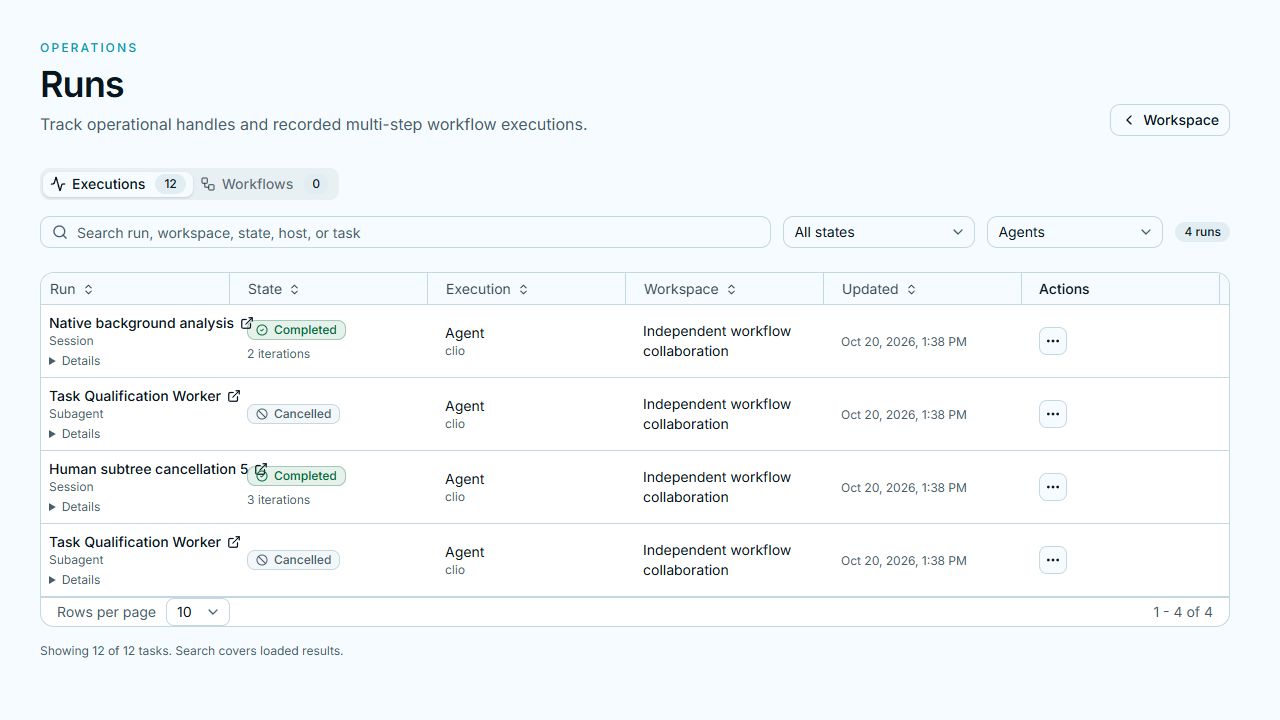
In Runs, select All states to include earlier outcomes. The Agents filter shows human-started assignments and delegated children together. Open Details for an assignment or follow its name to the original conversation.
Choose what another session can do
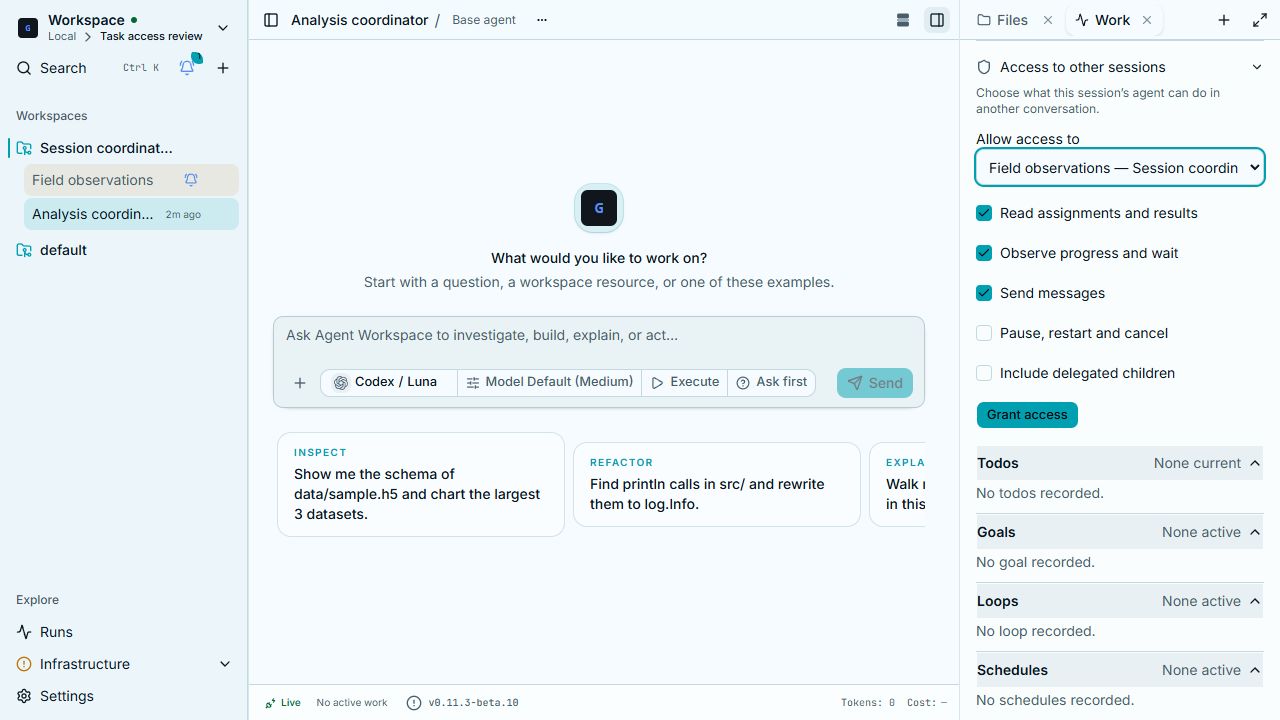
Section titled “Choose what another session can do”- Open the receiving session’s Work view and expand Access to other sessions.
- Choose the target conversation. Select read, observation and messaging rights according to the work you want these sessions to share.
- Select lifecycle control separately if that agent may pause, restart or cancel the target. Including delegated children is also a separate choice.
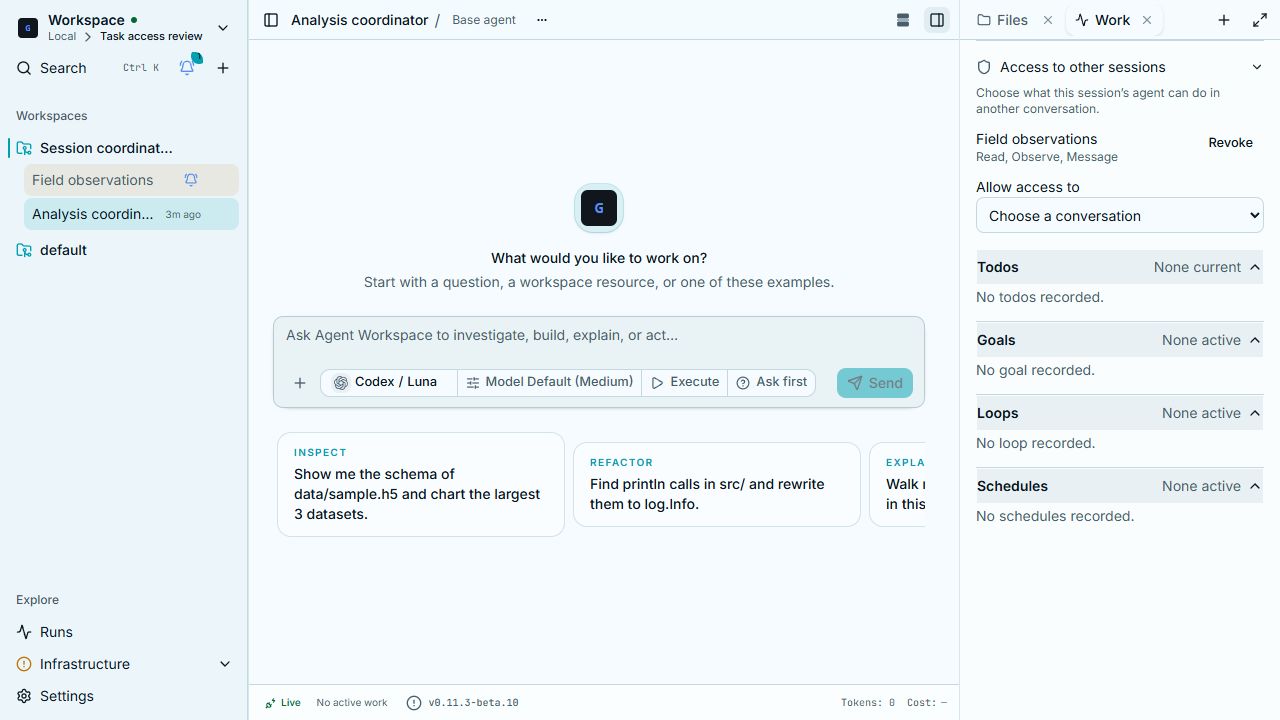
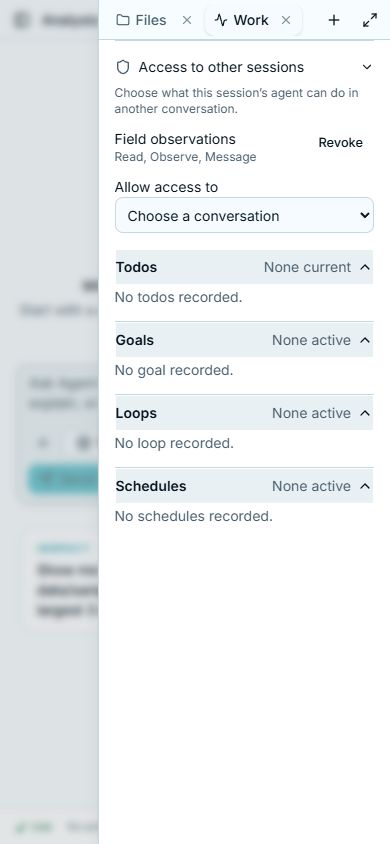
- Choose Grant access. Use Revoke to remove that exact relationship later.
An observation-only grant exposes status and numeric progress, not assignments, answers or output. Subscribing to the eventual result requires both read and observation rights. Revocation is checked again before queued content is injected.
Find a run and subscribe to its result
These are agent tool calls. Broader reads require a coordination grant created by an authenticated human or trusted configuration. A model’s description of user intent creates no permissions. Authorization is applied before filtering and pagination; knowing a handle does not bypass it.
query_tasks("Session", scope="authorized")observe_tasks(run_handle, notify=True)wait_tasks(run_handle, timeout_s=0)Use a returned run handle for a particular outcome. Use the stable session address for messages across executions. A subscribed completion enters the next model iteration when busy or wakes the observer when idle. It does not consume the owner’s notification. A later message can start a new run with a new handle.
Read the work behind a task
Section titled “Read the work behind a task”An authorized agent can inspect another session’s original transcript, including its tool observations, before deciding what to ask or reuse. The same reads work for a parent’s delegated children.
query_tasks(kind="Session", scope="authorized", query="archive storage")observe_tasks(tasks=run_handle, view="transcript")observe_tasks(tasks=run_handle, view="summary")observe_tasks(tasks=run_handle, view="artifacts")Search matches the supplied words in readable assignments and retained text.
Follow query cursors, including after a short page. Transcript pages keep source
message and part IDs; large rows return resumable JSON fragments. Follow the
returned cursor while has_more is true.
A summary view contains recorded compaction summaries or the assignment’s stored
outcome, with coverage and source references. It explicitly reports missing
summaries. It does not generate a new whole-session summary. An artifact view
lists linked versions; pass a listed artifact_id to the same view to read its
bounded content and recorded hash through the normal artifact permissions.
The default history="assignment" stays on that finite run. Reading predecessor
context with history="session" requires stable-session read permission. An
exact historical grant does not expand to later assignments. These views do not
consume result notifications, and copied text retains its original attribution.
Recorded Codex/Luna and Claude Opus runs exercised transcript inspection followed by messaging the original cancelled-child handle. The linked continuation used retained context without repeating the original operation. These are scoped demonstrations. The current candidate also has scoped summary/artifact evidence; the workshop conversations above show a model reading a peer’s recorded summary, listing its artifact and reading the saved note before sharing it. The screenshots of grants alone do not qualify every transcript view.
A possible workflow
Section titled “A possible workflow”This is a design example, not a recorded demonstration:
- An acquisition session accepts five scheduler jobs and returns handles tied to the actual scheduled work.
- An analysis session observes those handles and works on the existing data.
- When the jobs settle, its subscription wakes it with the available outcomes.
- It collects the results, messages the acquisition session with revised inputs, and starts the next iteration.
The scheduler adapter must distinguish job submission from job completion. The workflow also needs explicit outcomes for partial failure, interruption and cancellation; a finished submission command cannot stand in for them.
What the current demonstration proves
Section titled “What the current demonstration proves”Actual Codex/Luna agents in two distinct declared workflows used the replacement service on Windows through the direct SSE bridge. Separate root and child runs discovered authorized peers, exchanged attributed messages, observed and subscribed to work, expired a wait while the work continued, and were denied cancellation without control rights. A queued reply remained private after revocation and arrived once access was restored. Child-owner and subscriber completion records were independent; a completed human-owned root did not wake itself.
The root run also demonstrated observation-only redaction, a denied result read, desktop granting and phone revocation through the real UI. One model initially declined messaging and needed one feedback clarification before using the exposed control.
A later recorded Codex/Luna run completed the busy-message and historical-handle cases between two independent declared workflows. A peer request arrived while the recipient waited on real Shell work, and its reply continued the other session without human steering. Revocation withheld pending messages and results; the agent’s result read was denied. Restored access admitted each retained notice once, while the owner’s delivery remained independent. A linked successor could read the completed original handles without rerunning either workflow.
These scoped demonstrations do not accept every inference route, lifecycle or recovery race. They do not demonstrate a distributed scheduler or Slurm integration.
Read Messages and feedback for the implemented addressing and mailbox behavior, and Background work for accepted task execution.
On the current candidate, a separate real-service check granted Read, Observe and Message at desktop width, then revoked the relationship with the keyboard at 390-pixel phone width. Core confirmed the rights before and after; Control was never granted, the peer’s Question stayed pending, and the page had no overflow or browser errors. This interface check complements the separate actual-model workflow and permission-boundary evidence.